




Safety Guidelines for Using YOKE Swivel Hoist Rings
Classification:
Time:
2025-07-14
Hazards and Countermeasures of Using YOKE Rotary Hoist Rings
When using YOKE swivel hoisting rings, some users may employ improper operating procedures. If these incorrect practices persist, they can not only damage the equipment but also pose a serious risk of personal injury or even accidents. To ensure a safe working environment, we have compiled a list of common misuse scenarios to help everyone prevent and correct them.
Selection of Lifting Method
When operating a YOKE swivel lifting ring, selecting the correct lifting method is critical. An improper lifting approach may prevent the ring from securely engaging the load, thereby compromising lifting performance. Likewise, rigging components must be used with care to ensure proper compatibility with the lifting ring, thus avoiding safety hazards caused by misuse. Furthermore, during the lifting operation, the locking plate must be removed to allow the lifting ring to function smoothly.
Precautions for Hanging Orientation
During hoisting, using the incorrect orientation can render the snap ring in the side‑pull lifting eye ineffective. In particular, when employing a spring‑loaded hook for lifting, ensure that the spring faces outward to prevent the load from slipping off during the lift.
Follow the instructions and training.
So, how can you use a swivel lifting eye correctly? The key is to follow the instructions in the lifting‑point manual regarding method of use and angle during hoisting. At the same time, you must select an appropriate lifting point based on the rated capacity of the lifting equipment and ensure there are no obstructions between the lifting point and the workpiece. Furthermore, when using a laterally rotating lifting point, pay close attention to coordination with the lifting equipment to ensure the task is completed safely and efficiently. Providing thorough product training for on‑site operators is also an essential step.
Quality control, testing, and monitoring are conducted throughout the manufacturing process. YOKE maintains stable, rigorously managed production facilities, with quality control measures in place at every stage—from raw materials to finished products.
YOKE is an ISO 9001‑certified company and has obtained type approvals from leading international organizations, including DGUV, ABS, API, and DNV.GL, thereby ensuring high‑quality R&D and superior product manufacturing processes.
■ Magnetic Particle Inspection: All forged metal chain components undergo magnetic particle inspection following heat treatment.
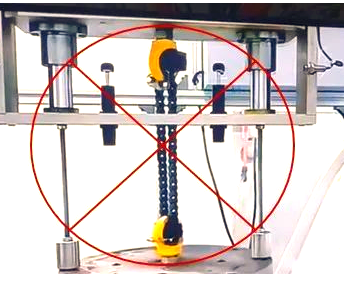
■Manufacturing Verification Load Test: All YOKE’s YP safety lifting points are tested at 2.5 times the working limit load, with allowable deformation not exceeding 1%.
■ Dynamic Fatigue Testing: Batch samples of the YOKE YP safety lifting points are subjected to 20,000 cycles of dynamic fatigue testing at a load equal to 1.5 times the working load limit.
■ Small‑break load testing: Batch samples of chains and components are subjected to small‑break load testing on a static tensile testing machine to determine their ultimate failure behavior. The small‑break load is equal to the working limit load multiplied by the safety factor.
■ Spectral Analysis: Ensure that the metallurgical composition of all raw materials is within specifications.
Latest News
Related Products


Contact Us

Address: Beigang Industrial Park, No. 28 Shucheng Road, Hongshan District, Wuhan City, Hubei Province, China

Mobile: 86-18674085456

Phone: 86-027-88137773

E-mail: liyanhe@noblifting.com

©2023 NOB Machinery Equipment (Wuhan) Co., Ltd. SEO Business license This site supports IPV6